The two names for the fear of long words, where they come from, why one is 35 letters long, and how to pronounce it.
The phobia of long words has a name, and the name is 35 letters long.
It’s called hippopotomonstrosesquipedaliophobia — a word so large it looks like a typographical accident. If you’ve been searching for this term and finding conflicting spellings, different origin stories, and vague claims about whether it’s a “real” condition, you’re not imagining the confusion. The term has a genuine linguistic history, but that history is messier and more interesting than most pages let on.
This article explains both names for the fear of long words, breaks down where they come from, traces the origin as far as verifiable sources allow, and gives you a way to actually pronounce the thing.
What Is the Phobia of Long Words Called?
The phobia of long words goes by two names.
The long one is hippopotomonstrosesquipedaliophobia — 35 letters, 15 syllables, and widely cited as one of the longest words in the English language. Wiktionary, which has an entry for it, labels it “(humorous).”
The short one is sesquipedalophobia — 18 letters and considerably easier to say. Wiktionary cites an example of this shorter form from Verbatim, a journal of language, as early as 1983. The longer form’s earliest citation currently listed by Wiktionary is from The Scotsman newspaper on April 19, 2002.
Both names share the same core: the sesquipedal- element, which traces back to the Latin word sesquipedalis. More on that in a moment — it’s where the story gets interesting.
Hippopotomonstrosesquipedaliophobia vs. Sesquipedalophobia
The shorter term, sesquipedalophobia, is built from two pieces: sesquipedalian (a real English word meaning “having many syllables”) plus -phobia (fear). That’s how phobia names are typically constructed — a root describing the feared thing, plus the Greek suffix for fear.
The longer term takes that same foundation and piles on. Wiktionary analyzes it as an extension of sesquipedalian using elements borrowed from monstrum (the Latin root behind “monster”) and hippopotamus — not because the fear has anything to do with hippos, but because both words evoke something enormous. The additions were made to exaggerate the word’s own length, making it an example of the very thing it describes.
One complication: you’ll find the word spelled two ways. Some sources double the “p” in the middle — hippopotomonstrosesquippedaliophobia — producing a 36-letter variant. Wiktionary currently labels the doubled-p form a common misspelling. Neither version has an entry in Merriam-Webster, so there’s no conventional dictionary to settle the question.
Why Is the Name So Long?
The irony is the point.
Whoever assembled this word wasn’t trying to create a neutral clinical label. They were building a joke — one where the name for the fear of long words is itself terrifyingly long. The construction stacks Greek and Latin roots that all gesture at bigness and monstrousness, turning what could have been a straightforward 18-letter term into a 35-letter spectacle.
It’s not the only self-referential phobia name that circulates online. “Aibohphobia,” supposedly the fear of palindromes, is itself a palindrome — “aiboh” reversed. Like the long-words phobia name, it’s wordplay rather than clinical terminology.
What Does “Sesquipedalian” Mean?
This is the part of the story with solid ground under it.
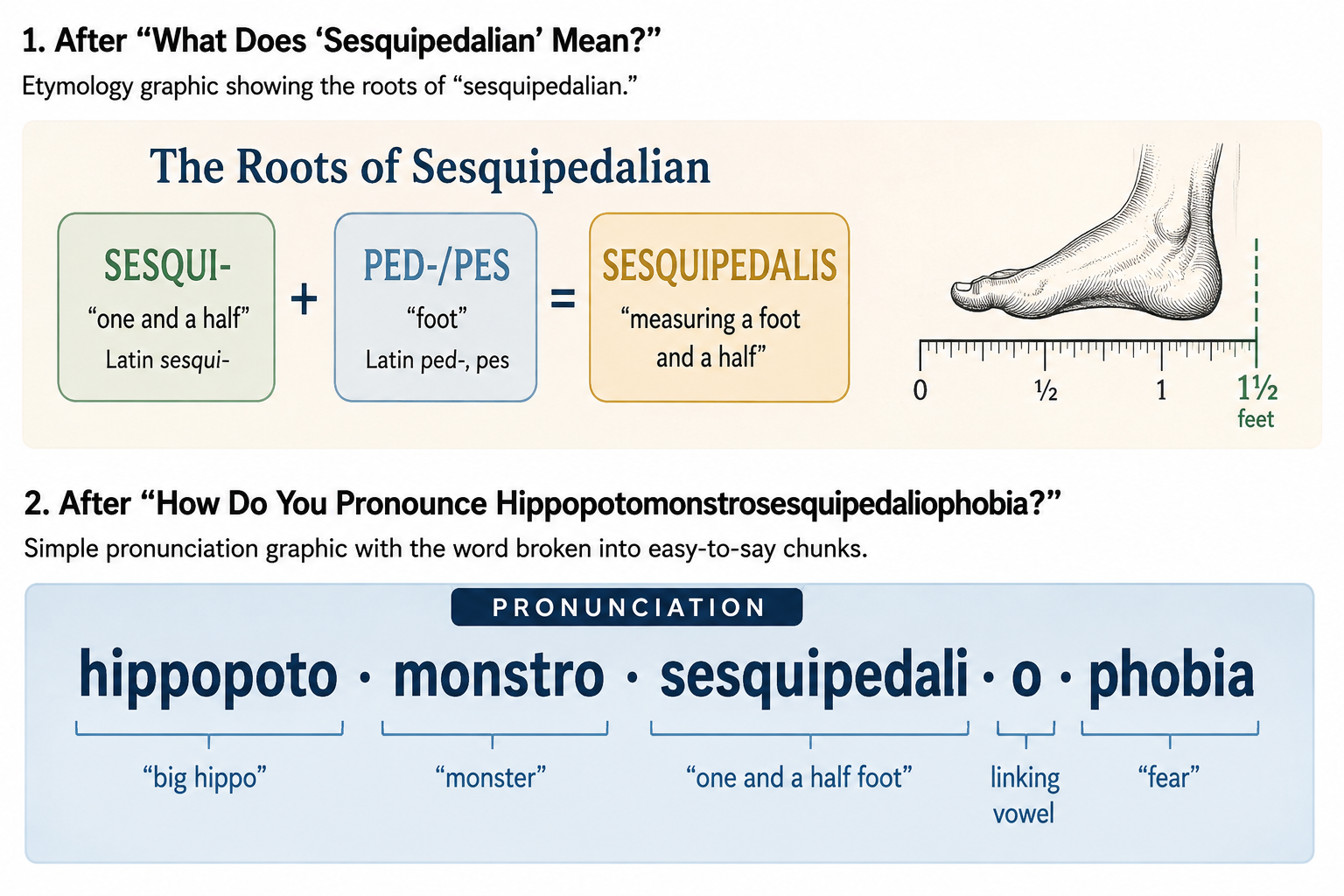
Merriam-Webster defines sesquipedalian as “having many syllables; long.” The word comes from Latin sesquipedalis, which literally means “measuring a foot and a half.” The prefix sesqui- means “one and a half” — you see it in sesquicentennial, a 150th anniversary — and ped-/pes means “foot.”
The phrase goes back to the Roman poet Horace. As Merriam-Webster notes, Horace used sesquipedalia verba — “words a foot and a half long” — in his Ars Poetica as a gentle warning to young poets against using unnecessarily bloated language. By the 17th century, English literary critics had adopted sesquipedalian for the same purpose: mocking writers whose vocabulary outran their ideas. Merriam-Webster gives 1656 as its first known use in English.
So when someone says “phobia of long words,” the sesquipedal- at the heart of both names carries over two thousand years of people complaining about the exact same problem — words that are longer than they need to be.
Where Did the Long Phobia Name Come From?
This is where the trail gets less certain — and where many sources get the chronology wrong.
BBC Science Focus attributes the longer form to the American poet Aimee Nezhukumatathil, placing the coinage around 2000. But the word appears in print well before that. A published use has been documented in Dennis Coon’s Introduction to Psychology: Exploration and Application from 1980, predating the BBC’s attributed coinage by two decades. The earliest citation currently listed by Wiktionary is from The Scotsman newspaper on April 19, 2002 — later than the Coon textbook, but specific enough to confirm the word was circulating in mainstream print by then.
Nezhukumatathil did use the word as a poem title in her 2007 collection At the Drive-In Volcano, published by Tupelo Press — a detail confirmed by the University of Arizona’s VOCA poetry archive. But the available evidence contradicts the claim that she coined it.
Wiktionary describes the word’s construction as using “ad hoc combining forms” from monstrum and hippopotamus, intended to exaggerate the word’s length. That description — deliberate, playful, built for effect — fits the word’s character, even if we can’t pin down exactly who first assembled it.
The honest answer: the longer name was in use by at least 1980. Its specific origin remains undocumented.
Is It an Officially Recognized Phobia?
APA materials use specific phobia as a diagnostic category; hippopotomonstrosesquipedaliophobia should not be presented as an APA diagnostic label. For the broader topic, see Types of Phobias.
BBC Science Focus describes the long term as “amusing wordplay, not a genuine medical condition.” Wiktionary labels it “(humorous).”
None of that means people can’t experience real discomfort around long or unfamiliar words. It means the 35-letter name is a popular coinage — an entertaining piece of language — not a clinical label.
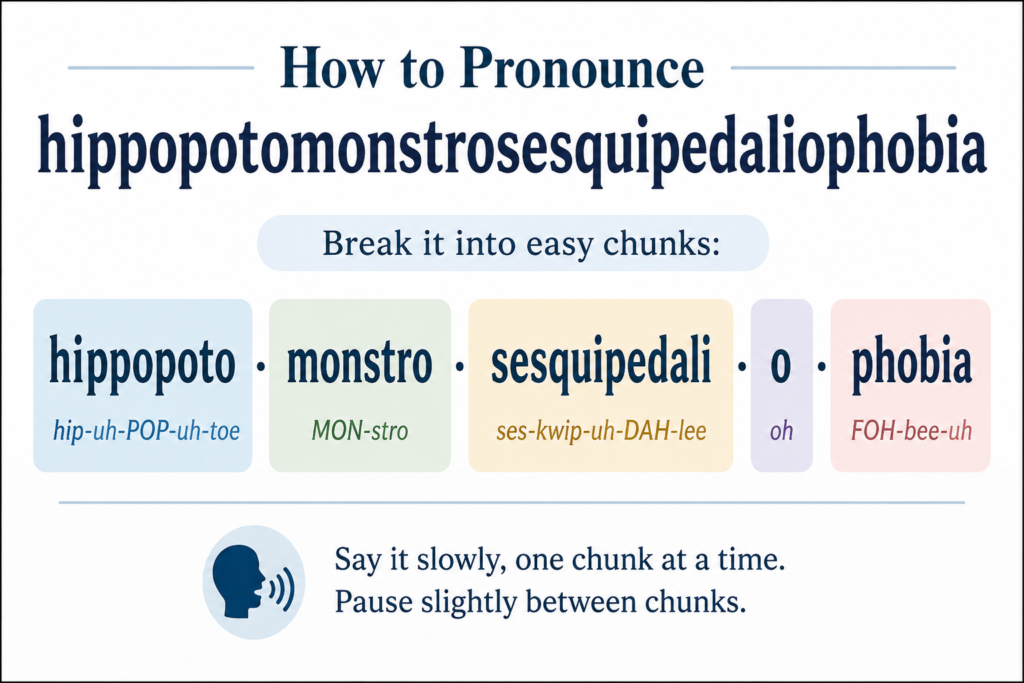
How Do You Pronounce Hippopotomonstrosesquipedaliophobia?
The word doesn’t appear in Merriam-Webster, so there’s no conventional dictionary pronunciation to point to. Wiktionary provides one documented UK pronunciation for the long form and breaks the word into 15 parts:
hip · po · po · to · mon · stro · ses · qui · pe · dal · i · o · pho · bi · a
Any simplified phonetic rendering would be an approximation rather than a definitive pronunciation — but the syllable breakdown above makes the word considerably less intimidating than it looks. Read it one cluster at a time and it stops being a single impossible word.
The shorter term, sesquipedalophobia, breaks into eight syllables: ses · qui · pe · dal · o · pho · bi · a.
Frequently Asked Questions
How many letters are in hippopotomonstrosesquipedaliophobia?
The single-p spelling has 35 letters. A common variant doubles the “p” in the middle (hippopotomonstrosesquippedaliophobia), producing 36 letters. Wiktionary currently labels the doubled-p form a common misspelling rather than listing both as equally standard.
What is the shorter name for the phobia of long words?
Sesquipedalophobia — 18 letters. Wiktionary cites usage of this form going back to at least 1983.
Is hippopotomonstrosesquipedaliophobia in the dictionary?
It’s not in Merriam-Webster. It does appear in Wiktionary, where it’s labeled “(humorous).” Wiktionary is a community-edited reference, not a conventional dictionary.
What does sesquipedalian mean?
Merriam-Webster defines it as “having many syllables; long.” It comes from the Latin sesquipedalis, meaning “measuring a foot and a half.” Merriam-Webster gives 1656 as its first known use in English.