The photograph did most of the work.
Two pale, many-legged animals hang beneath a soldier’s hand, their jaws prominent and their bodies apparently enormous against the figures standing farther away. During the Iraq War, versions of that image moved rapidly through email chains, forums, and early social media. So did the stories.
Camel spiders, people were told, could sprint alongside vehicles. They could jump several feet. They screamed while running. They chased humans deliberately. Their bites contained anesthetic venom, allowing them to chew flesh from sleeping people without waking them. Some versions of the story had them attacking camels.
It was nearly perfect monster-making material: an unfamiliar animal, an unfamiliar desert, a war zone, enormous jaws, and a photograph whose forced perspective made a creature only a few centimeters long appear grotesquely oversized.
Almost everything memorable about the story was wrong.
The camel spider is not a spider. It is not a scorpion. It does not hunt camels, and the notorious stories about anesthetic venom have no credible basis. What it actually is—a member of the arachnid order Solifugae—is considerably more interesting.
Strip away the folklore and you find an animal engineered for a demanding existence: locate prey rapidly, overpower it with formidable mouthparts, avoid predators, manage extreme temperatures, and conserve enough energy and water to survive landscapes in which exposure itself can be costly.
The real camel spider does not need exaggeration. Its biology is strange enough.
The Camel Spider Is Not Actually a Spider
The name is the first problem.
“Camel spider” is one of several common names given to solifuges, members of the order Solifugae. Depending on where you are, they may also be called sun spiders, wind scorpions, wind spiders, or solpugids.
None of those names should be taken literally.
Solifugae is a distinct arachnid order. True spiders belong to Araneae. Scorpions belong to Scorpiones. Camel spiders share the broader arachnid blueprint—most notably four pairs of walking legs—but represent their own evolutionary lineage.
More than 1,200 solifuge species have been described worldwide. They occur especially in warm, dry regions of Africa, the Middle East, Asia, and the Americas, although describing them simply as “desert animals” misses some of their ecological diversity.
What immediately distinguishes them is their front end.
A solifuge possesses a pair of enlarged pedipalps that it often holds forward while moving. To an observer unfamiliar with arachnid anatomy, those appendages can make the animal appear to have ten legs.
Then there are the chelicerae.
They are difficult to ignore.
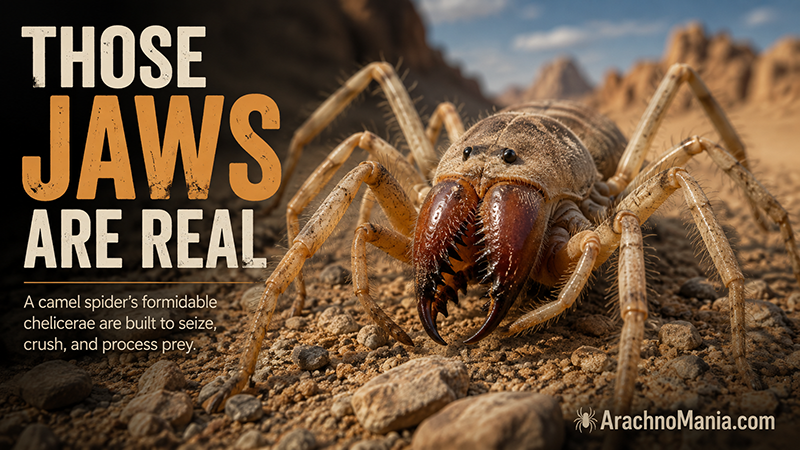
Those Jaws Are Real
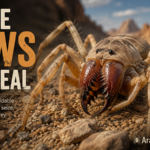
If the camel spider has one feature that deserves its intimidating reputation, it is the paired chelicerae at the front of its body.
In true spiders, the chelicerae usually terminate in fangs and are commonly associated with venom delivery. Solifuge chelicerae operate differently. They are heavily developed mechanical mouthparts armed with teeth and driven by considerable musculature.
They grip. They cut. They crush. They manipulate.
For a predator that often feeds on arthropods, this is an effective toolkit.
The result can look almost mechanical when a solifuge feeds. The chelicerae repeatedly work the prey, breaking tissue down before soft material is ingested. The pedipalps help detect, capture, and control what the animal encounters.
Solifuges are generally opportunistic predators. Depending on species and size, documented prey includes insects, spiders, other arachnids, and various small animals they are capable of overpowering. Larger individuals may occasionally take small vertebrates.
But this is where human storytelling usually abandons scale.
A predator formidable to a cricket or beetle does not automatically become a threat to a person.
The camel spider looks monstrous because the structures we notice first really are impressive relative to the rest of its body. The mistake is assuming those structures evolved with us in mind.
They did not.
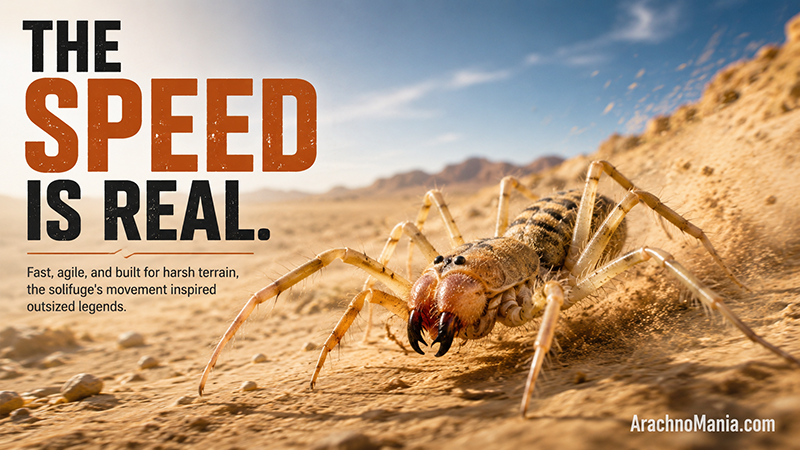
The Speed Is Real. The Legend Is Not.
Camel spiders can move quickly, and anyone who has watched one cross open ground understands why speed became central to the folklore.
But there is an important distinction between observing that an animal is fast and knowing precisely how fast an entire group of more than a thousand species can run.
Scientific reviews have pointed out that solifuge locomotion remains surprisingly poorly quantified. Despite decades of stories assigning spectacular top speeds to camel spiders, rigorous comparative measurements across species are scarce.
What researchers can say with confidence is that rapid locomotion appears to be an important part of solifuge biology.
That makes ecological sense.
Many solifuges occupy environments where food may be scattered and conditions can change rapidly. A mobile predator can cover more ground while searching for prey or mates. Yet speed also carries costs. Movement consumes energy, and for an animal living in a dry environment, extended activity can contribute to water loss.
That creates an intriguing evolutionary tension.
Move more and you may find more food.
Move more and you also spend more energy finding it.
For scientists, that relationship raises better questions than any viral claim about a camel spider outrunning a human. How does locomotor performance vary among species? Are daytime species built differently from nocturnal ones? Do males travel faster or farther because they are searching for females? How do temperature and dehydration alter performance?
The familiar claim—“camel spiders are incredibly fast”—turns out to be the beginning of the scientific story, not the conclusion.
Why a Camel Spider Might Appear to Chase You
Imagine standing in intense desert sunlight when a fast-moving arachnid suddenly runs toward your boots.
You step away.
It changes direction and follows.
You move again.
It follows again.
From the human perspective, the interpretation seems obvious: the animal is chasing you.
But movement toward a person is not the same thing as predatory pursuit.
One explanation repeatedly associated with camel-spider encounters is shade seeking. A human standing beneath powerful sunlight creates a large moving shadow. An animal attempting to escape exposed ground may continue moving toward that patch of shade as the person moves away.
To the solifuge, the target may be shelter.
To the human, it looks personal.
That distinction is central to understanding how camel-spider mythology became so durable. Human beings are exceptionally good at assigning intent to movement. Something that approaches us appears interested in us. Something that changes direction when we change direction appears to be tracking us.
Add speed, large jaws, unfamiliar anatomy, and surprise, and the encounter becomes a story before anyone has time to study what actually happened.
This is also why the famous military photograph proved so powerful. Forced perspective made relatively small animals appear gigantic. Once viewers believed they were looking at enormous desert predators, the surrounding stories suddenly felt plausible.
The image did not merely illustrate the legend.
It gave the legend permission to grow.
Does a Camel Spider Have Venom?
The venom story is one of the most persistent camel-spider myths because it explains another part of the folklore: how an animal could supposedly remove flesh from a sleeping victim without being noticed.
The proposed answer was an anesthetic venom.
There is no credible evidence for that scenario.
The camel spiders involved in the famous Middle Eastern stories do not possess the spider-style venom apparatus imagined in the legend, and claims of numbing bites followed by unnoticed feeding are part of the mythology rather than established biology.
That does not mean a camel spider should be handled casually.
An animal with powerful mechanical mouthparts may bite defensively if grabbed, restrained, or trapped against skin. A large individual can potentially break the skin, and any wound should be cleaned appropriately.
That is a very different risk from the one described in horror stories.
The distinction matters because myth-busting can become inaccurate in the opposite direction. Calling camel spiders “deadly” is misleading. Calling an animal with substantial jaws incapable of causing a painful mechanical bite would also be careless.
Nature rarely cooperates with the extremes we prefer.
Their Sensory World May Be Stranger Than Their Appearance
Once the sensational claims are removed, the less familiar parts of solifuge biology become far more interesting.
Consider the malleoli.
These are distinctive fan- or racket-shaped sensory structures located on the underside of the fourth pair of walking legs. They contain dense arrays of sensory structures associated particularly with chemical detection.
The pedipalps and other parts of the body also carry specialized sensory structures capable of helping the animal interpret its surroundings.
Researchers are still working out exactly how solifuges combine these inputs.
How do they locate prey?
How do males find females across open habitat?
How do they recognize burrows?
How important are chemical cues compared with vision or mechanical information?
Those questions remain open partly because solifuges are not ideal laboratory animals. They are active, fast-moving predators, and relatively few species have been examined in depth.
That creates an odd contradiction. Camel spiders are visually spectacular and culturally famous, yet scientifically they remain neglected compared with groups such as true spiders and scorpions.
We have spent more time exaggerating them than understanding them.
Even Their Relationship With the Sun Is Complicated
The scientific name Solifugae has long encouraged associations with fleeing from the sun, and many species are indeed active at night or seek shelter from extreme daytime conditions.
But the group refuses to fit neatly inside its own stereotype.
Some solifuges are nocturnal. Others are active around twilight. Some are diurnal.
That variation makes them useful subjects for research into how animals adapt to different environmental schedules.
A predator operating at midday confronts a different sensory landscape from one hunting at night. It also experiences different thermal conditions, different risks of water loss, and potentially different predators and prey.
Researchers can therefore ask whether daytime and nighttime solifuges differ consistently in coloration, vision, sensory structures, physiology, or behavior.
Again, the interesting part appears only after the myth is discarded.
“Camel spiders hate sunlight” is simple.
The actual biology is not.
The Real Mystery Is How Little We Know
Perhaps the most surprising fact about camel spiders is not their speed, their mouthparts, or their appearance.
It is how much basic biology remains unresolved.
Although more than 1,200 species are known, only a small fraction have been studied intensively for life history, ecology, behavior, and sensory biology. Researchers continue to identify major gaps involving navigation, activity patterns, habitat use, communication, reproductive behavior, physiology, and locomotion.
Even mating can become an elaborate affair involving the chelicerae and pedipalps, with behavior varying among the species that have been observed closely.
For evolutionary biologists, that makes Solifugae unusually promising.
Here is a lineage spread across demanding environments, equipped with highly specialized sensory structures, remarkable mouthparts, rapid locomotion, and diverse activity patterns—and much of its biology remains available for someone to discover.
The camel spider is not a solved animal obscured by myth.
It is an understudied animal obscured by myth.
That is a much more important distinction.
The Monster Was the Least Interesting Version
There is a predictable pattern in popular natural history.
First, an animal becomes frightening.
Then someone corrects the exaggerations.
Finally, in an attempt to rehabilitate it, the animal is presented as harmless, gentle, or misunderstood.
The camel spider needs none of those transformations.
It is a predator.
It kills other animals for food. Its chelicerae are powerful because powerful mouthparts are useful when your survival depends on physically dismantling prey. It can move with startling urgency. If mishandled, it can defend itself.
None of that requires a story about screaming, human-hunting desert monsters.
The factual animal is better.
A camel spider belongs to an evolutionary lineage containing more than a thousand species. It carries specialized sensory equipment unlike that of the familiar spiders with which people confuse it. It negotiates a world shaped by hunger, temperature, dehydration, predators, prey, and the need to find mates across difficult terrain.
Scientists are still determining how its sensory systems work, how different species navigate, how their activity schedules evolved, and why their anatomy varies across environments.
The famous photograph made the camel spider look larger than life.
Biology offers a different correction.
The animal was never too small for our attention.
Our story about it was simply too large.
References
- Burke Museum — “Myth: Too many ‘camel spider’ tall tales.” Background on the Iraq War photograph, forced perspective, venom myths, exaggerated size and speed claims, and apparent shade-seeking behavior. Burke Museum reference
- Zoological Journal of the Linnean Society — “A scientist’s guide to Solifugae: how solifuges could advance research in ecology, evolution, and behaviour.” Peer-reviewed review covering solifuge diversity, locomotion, sensory structures, ecology, behavior, and major gaps in scientific knowledge. Oxford Academic reference