Spider biology is a study in integration: silk becomes architecture and sensor, pressure assists movement, venom manages dangerous prey, and a conservative body plan supports more than 54,000 variations on the predatory life.
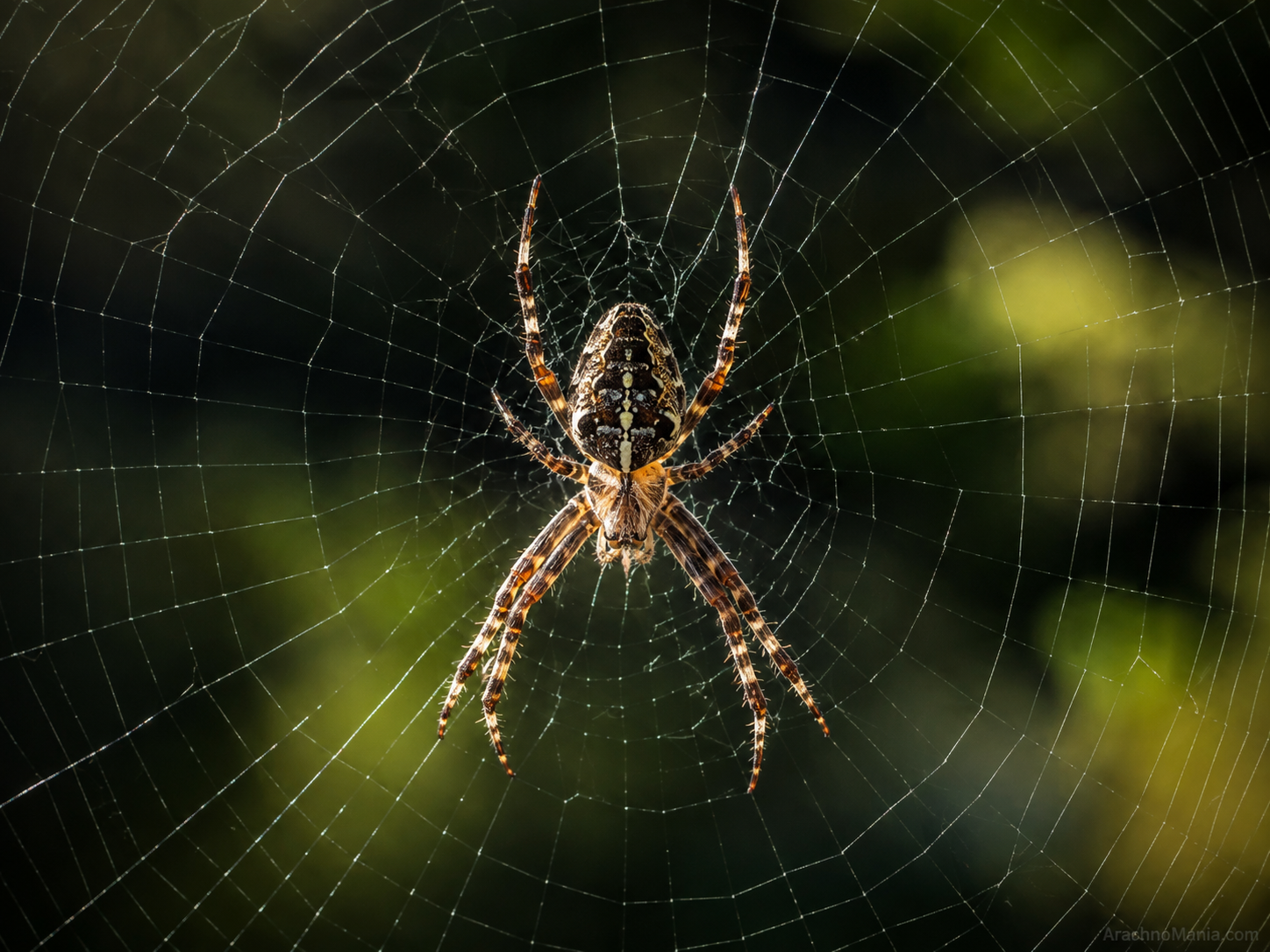
A spider at the center of an orb web is not waiting passively. It is listening with its entire body.
A moth clips a capture spiral, and the web converts that collision into a pattern of tension. The spider does not need to see the insect clearly. Vibrations travel through silk, enter the legs, deform microscopic sensory structures in the cuticle, and become neural signals. Within moments the spider can turn toward the disturbance, cross its own architecture, subdue the prey, and begin feeding.
That sequence captures something essential about spider biology. Spiders are often reduced to their most conspicuous products—webs, venom, fangs—or to the familiar silhouette of eight legs. But the animal is more interesting than any one of those traits. A spider is an integrated predatory system built around sensitivity, material control, and extreme economy. Its body does not simply occupy the environment; it samples tension, airflow, light, vibration, chemistry, and pressure, then converts those signals into behavior.
There are now 54,069 described spider species in 139 recognized families, according to the World Spider Catalog, and that diversity makes almost every simple statement about “the spider” dangerous. Some hunt on foot. Some wait in burrows. Some cast nets, build trapdoors, ambush pollinators on flowers, or stalk prey with vision precise enough to guide calculated leaps. What unites them is not one lifestyle but a remarkably durable body plan.
One Body, Two Functional Worlds
A spider is divided into two main body regions. The front region, the prosoma—often called the cephalothorax—carries the eyes, mouthparts, pedipalps, and four pairs of walking legs. Behind it sits the opisthosoma, or abdomen, which contains much of the digestive, reproductive, respiratory, circulatory, and silk-producing machinery. A narrow pedicel connects the two.
That arrangement creates a useful division of labor. The prosoma is the spider’s platform for sensing, locomotion, prey handling, and attack. The opisthosoma supports the physiological infrastructure that makes those actions possible.
At the front are the chelicerae, paired appendages ending in fangs. In most spiders, venom glands feed those fangs through ducts. Beside them are the pedipalps, shorter appendages that help manipulate food and sample the environment; in adult males, their terminal segments are modified into elaborate sperm-transfer organs. The result is a compact front end in which sensory, feeding, defensive, and reproductive functions are crowded together.
This architecture is ancient. Spiders have inhabited terrestrial ecosystems for roughly 400 million years, yet the basic design has proved flexible enough to produce lineages as different as heavy-bodied tarantulas, long-legged cellar spiders, cryptic crab spiders, and visually sophisticated jumping spiders.
Spider Biology: Walking on Muscle, Pressure, and Misunderstanding
Spider locomotion is frequently described as “hydraulic,” which is true only if the word is used carefully.
Several major joints in a spider’s legs lack the extensor muscles that vertebrates use to straighten a limb. Instead, internal hemolymph pressure contributes to extension, working against flexor muscles that bend the joints. The system allows slender legs to devote substantial internal space to flexor musculature while using body pressure as part of the extension mechanism.
But a spider is not an eight-legged hydraulic machine in the simplistic engineering sense. Research on large running spiders has shown that muscle forces can dominate some phases of locomotion, while hydraulic pressure modulates joint movement and force direction. The useful picture is therefore hybrid: muscles, joint mechanics, elastic tissues, and fluid pressure work together.
That nuance matters because spider biology is full of mechanisms that become less interesting when turned into slogans. “Spiders move by hydraulics” sounds exotic. The real mechanism—distributed control between muscle and pressure—is more sophisticated.
It also helps explain a familiar sight. After death, a spider often draws its legs inward because active control of the pressure-and-muscle system has ceased and flexor forces dominate. The curled posture is not a mysterious death reflex; it follows from the mechanics that normally keep the animal moving.
Silk Is Not a Web
The most persistent misconception about spiders may be that silk exists primarily to build webs.
All spiders use silk, but many species do not build prey-catching webs at all. Silk is better understood as a biological material platform. Depending on species and life stage, it can become a dragline, shelter, egg case, prey restraint, attachment disc, mating signal, dispersal thread, or structural element of a trap.
Orb-weaving spiders reveal the system at its most specialized. Some can produce as many as seven functionally distinct types of silk or silk-associated material from specialized abdominal glands. Major ampullate silk forms draglines and much of an orb web’s framework. Flagelliform silk contributes the extensible core of the capture spiral. Aggregate glands supply the adhesive coating that helps retain prey. Other gland systems produce attachment structures, prey-wrapping silk, or protective egg-case material.
The crucial point is not that spider silk is “stronger than steel,” a comparison usually stripped of the qualifications that make material science meaningful. Strength, stiffness, extensibility, and toughness are different properties, and different spider silks occupy different positions along those axes. What makes the system biologically impressive is controlled specialization: one animal can manufacture multiple protein-based materials and deploy them precisely where their particular mechanical behavior is useful.
A web, in that sense, is not merely a structure. It is behavior made physical.
A Nervous System That Reaches Into the Environment
Vision dominates human descriptions of animal perception because vision dominates human experience. Spiders make that bias obvious.
Many species rely heavily on mechanosensation. Fine sensory hairs can detect touch or air movement. Slit sensilla—tiny strain-sensitive structures in the exoskeleton, sometimes grouped into lyriform organs—respond when mechanical forces deform the cuticle. Substrate vibration, muscular activity, gravity, and forces transmitted through silk can therefore become biologically useful information.
For a web-building spider, silk extends this sensory world beyond the body. The web catches prey, but it also transmits information. A spider can respond differently to disturbances generated by struggling insects, potential mates, predators, or irrelevant environmental noise. The structure is simultaneously trap, transmission medium, and territory.
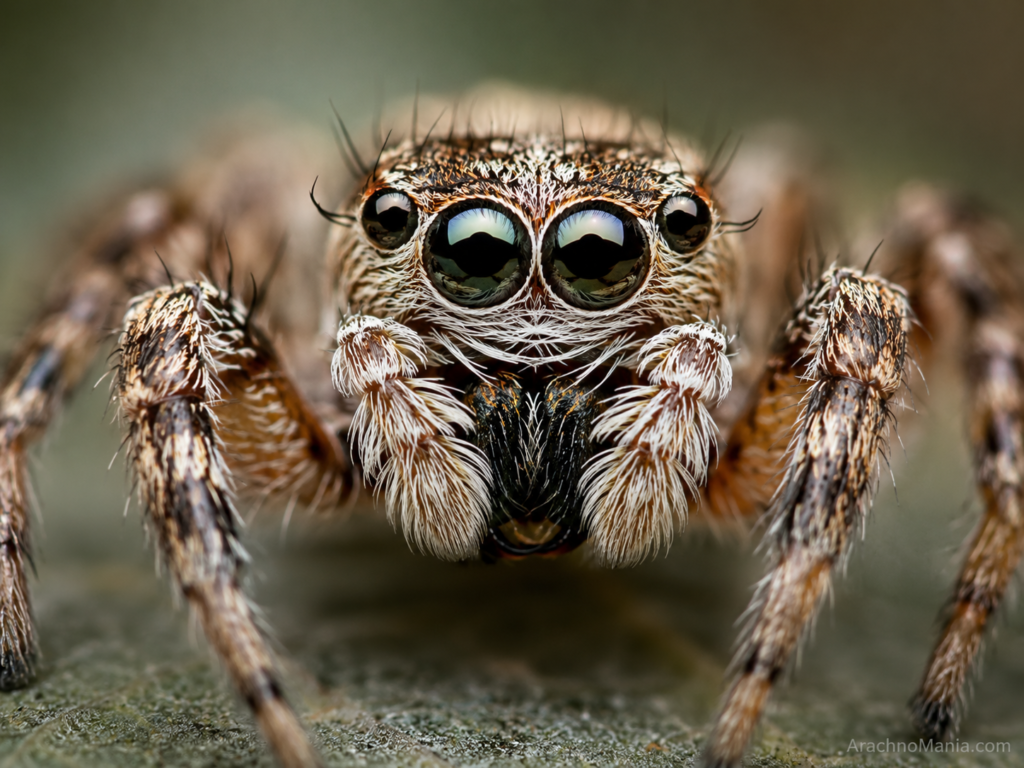
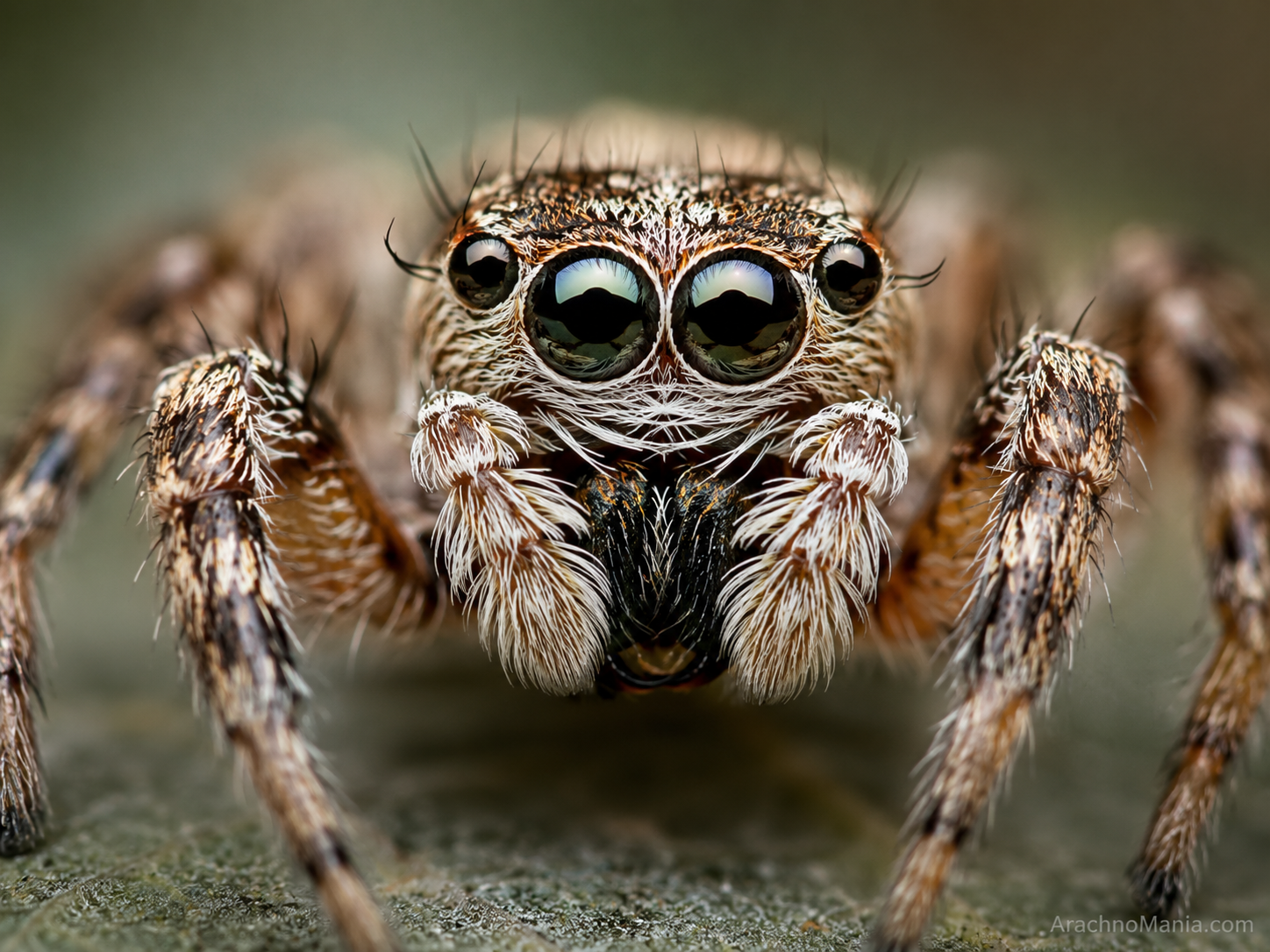
Then there are jumping spiders, which complicate the idea that spider senses are mostly tactile. Most spiders have eight eyes, although the number varies, and eye performance differs radically among lineages. Jumping spiders divide visual tasks among specialized pairs. Their forward-facing principal eyes provide high-resolution inspection, while secondary eyes contribute broader-field information about motion. Instead of asking one pair of eyes to do everything, the animal distributes visual tasks across a modular system.
That division supports stalking, courtship, navigation, and rapid orientation toward moving objects. A jumping spider may be tiny, but its visual behavior is not simple. It selects what to inspect.
Spider Biology: Venom Is a Toolkit, Not a Toxin
The fang is another place where popular shorthand obscures biology.
Spider venom is not a single chemical, nor is its function reducible to “poisoning.” Venoms are complex mixtures that can include peptides, proteins, enzymes, salts, and other components. Their composition differs among species and can also vary with factors such as sex, developmental stage, and biological role. Spider venom systems themselves are correspondingly sophisticated: venom glands are linked to the chelicerae by ducts, and their secretory tissues can produce multiple active components.
For a predator that often attacks active prey capable of fighting back, venom can shorten the dangerous interval between contact and immobilization. It is therefore part of an energy-and-risk economy. Silk may restrain; venom may incapacitate; chelicerae and mouthparts then participate in feeding. These systems overlap rather than operate as separate weapons.
Even the familiar rule has exceptions. The vast majority of spiders possess venom systems, but some lineages—notably the family Uloboridae—lack functional venom glands and compensate with silk and mechanical processing. That exception is biologically revealing: a spider does not require one fixed predatory technology. Evolution can redistribute the workload.
For humans, the relevant distinction is equally important. A spider can be venomous in the zoological sense—equipped to deliver venom—without being medically dangerous to people. Only a small fraction of spider species cause medically significant envenomation, and most verified bites from other species produce minor or transient effects. Venom evolved primarily in the ecological context of prey capture and defense, not as an adaptation for biting humans.
Courtship at the Edge of Cannibalism
Reproduction brings many of these systems together.
Male spiders do not transfer sperm with a penis. In typical spider reproduction, sperm is first deposited onto a small silk structure and then taken up into specialized palpal organs. During mating, the male uses those modified pedipalps to transfer sperm to the female.
Reaching that point may require elaborate communication. Depending on the species, males signal through web vibrations, substrate-borne pulses, body movements, chemical cues, conspicuous visual displays, or combinations of several channels. Courtship can communicate identity and reproductive intent while reducing the danger inherent in approaching another predator.
That danger is real, but the stereotype is not. Sexual cannibalism occurs in spiders and has shaped remarkable reproductive strategies in some lineages, yet it is not an inevitable ending to spider mating. Its frequency, timing, and evolutionary consequences vary among species. The familiar image of a female automatically consuming her mate compresses a complex field of sexual conflict, mate choice, signaling, and risk management into folklore.
Silk appears here again: in sperm webs, retreats, egg sacs, courtship structures, and protective nurseries. The material that catches food also helps produce and protect the next generation.
The Spider’s Real Innovation
The deepest lesson in spider biology is not that spiders possess unusual parts. Plenty of animals have venom. Many arthropods make silk. Hydraulic mechanisms, acute vision, vibration sensing, and elaborate courtship all exist elsewhere.
What distinguishes spiders is the way these capabilities are integrated.
A spider can externalize part of its predatory behavior into silk, use its skeleton as a strain-sensing surface, combine fluid pressure with muscle to control slender limbs, and match venom chemistry to the ecological problem of subduing prey. Different lineages then emphasize different components. Orb weavers invest in architecture. Jumping spiders lean heavily on visual hunting. Burrowers turn silk and soil into defended microhabitats. Ambush hunters reduce the web and make the body itself the trap.
That is why the evolutionary success of spiders cannot be assigned to a single “superpower.” It rests on modularity: an ancient body plan repeatedly retuned for different sensory worlds and predatory problems.
Watch a spider closely and the familiar outline begins to dissolve. The legs are pressure-assisted actuators and sensory arrays. The exoskeleton is armor and instrument. The silk is material, message, lifeline, nursery, and sometimes weapon. The web, when there is one, is not simply where the spider lives.
It is part of what the spider is.