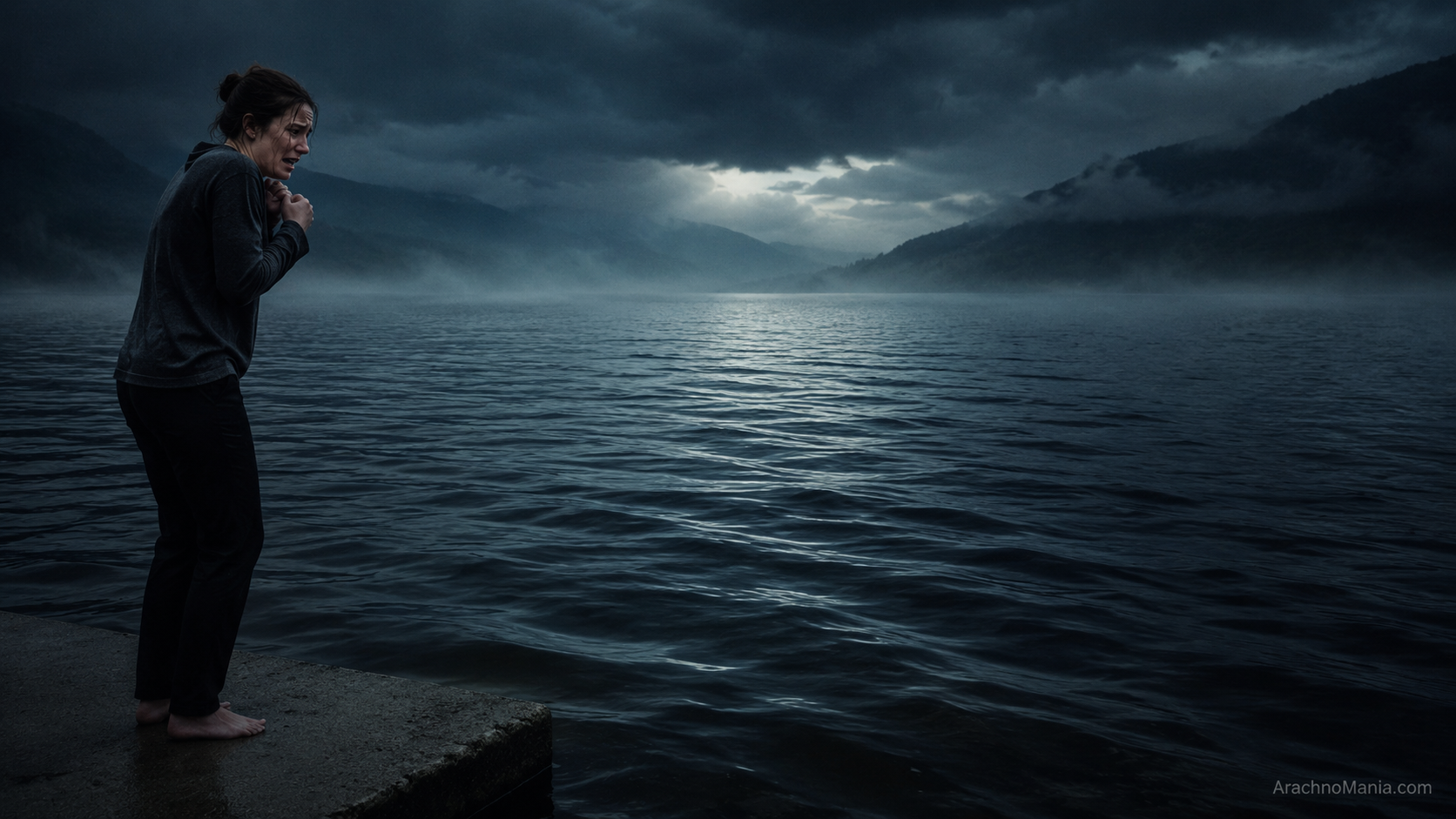
Most of us have a casual relationship with water, including a phobia of water. We shower without thinking, wade into lakes on summer weekends, watch rain bead on glass. Cross-national data do not isolate aquaphobia: one large study reports a lifetime prevalence of about 2.3 percent for a combined category of still-water and weather-event phobias¹. For people with aquaphobia, however, water in nearly any form can trigger a response so visceral it can feel indistinguishable from dying. Their pulse hammers. Their vision narrows. Their body screams a single, wordless instruction: get away.
This is aquaphobia, and it is far stranger, more varied, and more clinically interesting than the tidy dictionary entry suggests.
Hydrophobia – A Word, Misused for Centuries
Start with the name itself, because here is where most popular accounts already go wrong. “Hydrophobia” appears constantly in casual writing about water fear, but the term belongs to a different clinical reality entirely. Hydrophobia, in its precise medical sense, refers to the involuntary spasms of the swallowing muscles during rabies infection — spasms that can be triggered not only by attempting to drink but by the mere sight, sound, or anticipation of water. The spasms can produce genuine terror and avoidance in the patient, so the line between neurological symptom and psychological fear blurs at the bedside. But the cause is a fatal infection of the central nervous system, not a phobia.
Aquaphobia is the correct term for the persistent, disproportionate fear of water as a psychological condition. Clinically, it sits in the DSM-5-TR’s specific phobia category — the same diagnostic family that houses arachnophobia, acrophobia, and claustrophobia. The defining criterion is that the fear is out of proportion to the actual danger. Not that danger is absent — you can drown in water — but that the fear has broken loose from any reasonable assessment of the risk. And the person experiencing it may or may not recognize that. The DSM-5 dropped the old requirement that patients acknowledge their fear as excessive, because many don’t, and the suffering is the same either way.
The Spectrum No One Talks About
Here is the part that most surface-level treatments of this subject miss entirely: aquaphobia is not one fear. It is a constellation of fears that happen to share an element.
Some people cannot look at the ocean. Not swim in it — look at it. The sheer volume of open water, the sense of depth beneath a surface they can’t see through, activates something closer to existential dread than simple fright. This pattern is sometimes called thalassophobia — a descriptive label for fear of deep or open water, not a separate diagnosis, just a way of naming where the terror lives.
Others function perfectly well near oceans and lakes but cannot tolerate water touching their face. A shower becomes a negotiation. Rain becomes a threat. The trigger isn’t depth or vastness — it’s contact, the sensation of water against skin near the nose and mouth, which can feel like a suffocation threat even when breathing is completely unobstructed.
Still others fear only submersion. They can stand in a pool at waist depth without distress, but the moment their feet leave the bottom — the moment buoyancy replaces solid ground — the panic arrives with the force of a freight train. It may not be water itself that frightens them so much as the loss of footing, the removal of a fixed point the body trusts.
At the far end of the spectrum, some people fear water in any quantity. A glass on a table. A puddle on pavement. The sound of a running tap in the next room. Here, the phobia has generalized into a trigger so broad that daily life becomes an obstacle course.
None of these are established clinical subtypes. No diagnostic manual ranks or categorizes them. They are simply the varied shapes a single diagnosis can take, and clinicians encounter them in unpredictable combinations.
Phobia of Water – Where Does It Come From?
The etiology of aquaphobia resists a single, clean narrative, which is precisely why it interests researchers.
The classical conditioning model — the one most people encounter first — is the simplest. A near-drowning in childhood. A moment of submersion that lasted ten seconds too long. A parent’s panicked face at a pool’s edge. The event encodes water as a threat, the amygdala files the association, and the fear consolidates over time through avoidance. Each time the person successfully stays away from water, the brain registers the avoidance as having prevented a catastrophe, which deepens the phobic loop.
But conditioning doesn’t explain every case. In a study of fifty children with water phobia, most parents could not recall a specific triggering event, and fifty-six percent reported the fear had simply always been present.² That evidence is retrospective — parents may not remember what they didn’t witness — but it points to something real: a meaningful share of water phobia arrives without any obvious encounter with danger.
One explanation for this is Martin Seligman’s preparedness theory, proposed in the early 1970s, which holds that humans may be predisposed to acquire fears of things that genuinely threatened our ancestors — heights, snakes, deep water — more readily than fears of neutral objects. The idea is influential, and it fits the intuition that water fear has a different texture than, say, fear of elevators. But later reviews have found the experimental evidence mixed, with key predictions of the theory only weakly supported.³ Preparedness remains a compelling framework, not a settled answer.
Neuroimaging adds another partial view. Systematic reviews of fMRI studies in specific phobias have found altered brain activation — including in the amygdala and insula — when patients are exposed to images of the thing they fear.⁴ The picture is not uniform across studies, and it cannot yet tell us why a particular person fears water rather than spiders. But it confirms that phobic responses are not drama or weakness. They are visible in the brain, and they are real.

The Weight of a Fear That Sounds Small
One of the cruelest dimensions of aquaphobia is social. Water-based activities occupy an outsized role in recreation, socialization, and rites of passage. Pool parties. Beach vacations. Baptisms. Water parks with children. The person with aquaphobia doesn’t just avoid a substance — they avoid entire categories of human gathering.
The shame compounds quickly. Adults who cannot swim due to phobia often conceal the reason, citing vague disinterest rather than admitting terror. Parents with aquaphobia face an agonizing bind: they know their children need to learn to swim, but supervising lessons means sitting at the edge of a pool, close to the very thing that makes their hands shake. Some manage it through sheer willpower. Others send a partner or relative. Some avoid the question entirely, and their children grow up without learning, carrying forward a deficit rooted in a fear that was never theirs.
In cultures where bathing is communal — parts of Japan, Scandinavia, Korea — aquaphobia carries an additional social cost. The fear doesn’t just limit recreation; it marks you as outside a shared ritual. The isolation is not only practical but cultural.
Phobia of Water Treatment: What Actually Works
The clinical evidence here is, for once, relatively encouraging. Specific phobias respond well to exposure-based treatment.
The gold standard remains in vivo exposure to the feared stimulus. In its graduated form, it begins not with water but with hierarchy construction: the patient and therapist build a ranked list of water-related scenarios from least to most distressing — looking at a photograph of a lake, standing in a bathroom with the tap running, touching water in a basin, standing in ankle-deep water — and the patient moves through at their own pace. But exposure need not be slow. Meta-analytic evidence shows that even a single intensive session can produce clinically significant, lasting improvement.⁵ For a condition that reshapes someone’s entire life, that is a remarkable finding.
How exposure works is still debated. Inhibitory-learning models propose that the brain doesn’t erase the old fear so much as build a new, competing association⁶ — I was in the water and nothing happened — that gradually overrides the threat signal. The original trace may linger, which helps explain why relapse is possible even after successful treatment. But the corrective learning, once consolidated, tends to hold.
Cognitive-behavioral therapy layers additional structure onto the exposure work. The therapist helps the patient identify and challenge the catastrophic beliefs that feed the fear — If I go in the water, I will drown; I won’t be able to breathe; no one will save me — and replace them with more accurate assessments of risk. Evidence for cognitive approaches on their own is mixed, but combined with exposure they give the patient a framework sturdy enough to stay in the room when every nerve says leave.
Virtual reality has emerged as a promising adjunct. VR environments allow controlled, repeatable exposure to feared stimuli — a simulated pool, an animated coastline — with the therapist adjusting intensity in real time. Early evidence suggests the gains carry over to real settings, though the research is still developing.
Pharmacology plays a more limited role. Benzodiazepines can take the edge off acute anxiety, but they have shown no clear advantage as adjuncts to exposure, and whether they interfere with extinction learning remains an open question.⁸ D-cycloserine, an experimental augmentation once thought to enhance extinction learning, has produced only small, inconsistent benefits in a meta-analysis of individual participant data and has not entered routine practice.⁷
The Paradox Worth Sitting With
There is something worth pausing over in aquaphobia that the clinical literature rarely names directly. The human body is roughly sixty percent water. Every cell requires it. We developed, as a species, in intimate proximity to rivers, coastlines, and rain. We gestate in it. Our earliest sensory environment — before memory begins — was the feeling of warm liquid surrounding us completely.
To fear water is, in a sense, to fear a fundamental condition of being alive — to have the body reject one of the very substances it is made of. That paradox doesn’t resolve into a neat insight or a therapeutic takeaway. It just sits there, irreducible, a reminder that the nervous system was never designed for consistency. It was designed to keep us alive, and sometimes the machinery overshoots so badly that it turns the world’s most essential molecule into an enemy.
The people living with this fear are not fragile, and they are not irrational in any way that matters. However the fear was acquired — through a terrifying event, through a predisposition no one chose, through some convergence of biology and bad luck — it is real, it is costly, and for many people, it is treatable. Sometimes in a single session. Sometimes over months. The outcomes vary, but the direction of the evidence is clear: the same plasticity that let the fear take root can let it loosen.
Water, after all, is patient. It can wait.
References
- Wardenaar, K.J., et al. “The cross-national epidemiology of specific phobia in the World Mental Health Surveys.” Psychological Medicine, 47(10), 2017, pp. 1744–1760. PMC
- Menzies, R.G., & Clarke, J.C. “The etiology of childhood water phobia.” Behaviour Research and Therapy, 31(5), 1993, pp. 499–501. PubMed
- McNally, R.J. “The Legacy of Seligman’s ‘Phobias and Preparedness’ (1971).” Behavior Therapy, 47(5), 2016, pp. 585–594. PubMed
- Linares, I.M.P., Trzesniak, C., Chagas, M.H.N., et al. “Neuroimaging in specific phobia disorder: a systematic review of the literature.” Revista Brasileira de Psiquiatria, 34(1), 2012, pp. 101–111. PubMed
- Odgers, K., Kershaw, K.A., Li, S.H., & Graham, B.M. “The relative efficacy and efficiency of single- and multi-session exposure therapies for specific phobia: A meta-analysis.” Behaviour Research and Therapy, 159, 2022, 104203. PubMed
- Craske, M.G., Treanor, M., Conway, C.C., Zbozinek, T., & Vervliet, B. “Maximizing Exposure Therapy: An Inhibitory Learning Approach.” Behaviour Research and Therapy, 58, 2014, pp. 10–23. PMC
- Mataix-Cols, D., et al. “D-Cycloserine Augmentation of Exposure-Based Cognitive Behavior Therapy for Anxiety, Obsessive-Compulsive, and Posttraumatic Stress Disorders.” JAMA Psychiatry, 74(5), 2017, pp. 501–510. JAMA Network
- Melani, M.S., Paiva, J.M., Silva, M.C., Mendlowicz, M.V., Figueira, I., Marques-Portella, C., Luz, M.P., Ventura, P.R., & Berger, W. “Absence of definitive scientific evidence that benzodiazepines could hinder the efficacy of exposure-based interventions in adults with anxiety or posttraumatic stress disorders: A systematic review of randomized clinical trials.” Depression and Anxiety, 37(12), 2020, pp. 1231–1242. PubMed